


While summer holidays are in full swing and the excitement of the World Cup is still fresh, the festive season might feel a long way off. However, while families are planning BBQs, beach days, and getaways, many are already starting to think about holiday wishlists.
Our latest report, Holidays Unwrapped: How to Win the 2026 Wishlist, explores how kids and teens discover, evaluate, and ask for gifts, and what those behaviors mean for brands. We spoke to more than 2,000 kids, teens, and parents across the US, UK, Germany, and France to uncover how to get ahead this festive season.
Discover four key trends shaping the 2026 holiday season and how your brand can earn a place on this year’s wishlists before the wrapping paper comes out.

1. A Youth-Direct Strategy Helps Parents Get It Right
Parents may be tuned into the broad category on the wishlist, but the key is understanding the specific details of the ask – kids and teens’ requests go deeper than this. They are savvy consumers with hyper-specific asks. To them, receiving a new pair of sneakers is not the same as specifically receiving a new pair of Jordans.
This makes brand and product recall a direct route into the holiday purchase conversation. Kids and teens aren’t just asking for “a gaming console” or “a new phone.” Brands need to make their names, models, and titles clear and memorable enough for young audiences to make a precise request and for parents to act on it.
2. Parents Are Shopping Earlier than Ever
Across all four markets, parents share one overriding holiday shopping goal: choosing gifts that will make their kids happy. With that, planned budgets are on the rise – averaging $593 per child in the US, £452 in the UK, and around €340 in France and Germany.
The start of the holiday purchasing window has shifted earlier than ever before. Parents are starting their shopping well before November across all four markets. By December, an average of 86% of parents will have already started shopping.
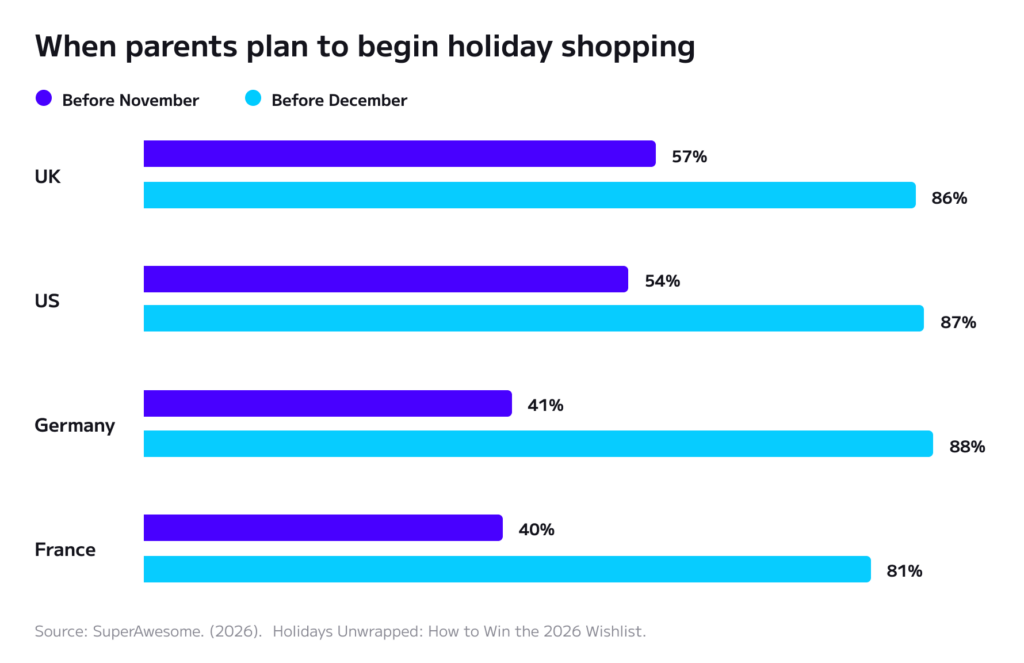
For brands, the opportunity is significant, but holiday campaign planning needs to start early to make it count. By the time peak shopping season arrives, many families have already begun making purchase decisions. Engaging kids and teens early gives brands more opportunity to influence what parents ultimately buy.
3. “Cool” and “Social Proof” Power the 2026 Wishlist
Being deemed ‘cool’ is the ultimate win for brands, with coolness carrying strong weight when it comes to social currency. Over ⅓ of kids and teens have named ‘it’s cool’ as the number one reason for adding something to their wishlists.
Alongside the ‘cool factor’, kids and teens also placed huge importance on their friends owning a product as a deciding factor when considering adding brands to their list, with almost 39% of those surveyed in the UK putting it as their number-one wishlist driver.
Our research shows that what makes a gift “cool” is increasingly driven by fandoms, with fandom influence up 5% YoY. For brands, earning a place on holiday wishlists means showing up authentically in the communities, content, and conversations that are already capturing young audiences’ attention.
4. The Wishlist Is Now Hybrid, and Choice Is Part of the Gift
The 2026 wishlist extends beyond traditional physical presents. Across all four markets, around half of kids and teens want a combination of physical and digital gifts. Many also want the freedom to choose for themselves, with around one in five asking for money they can spend on the gifts they want.
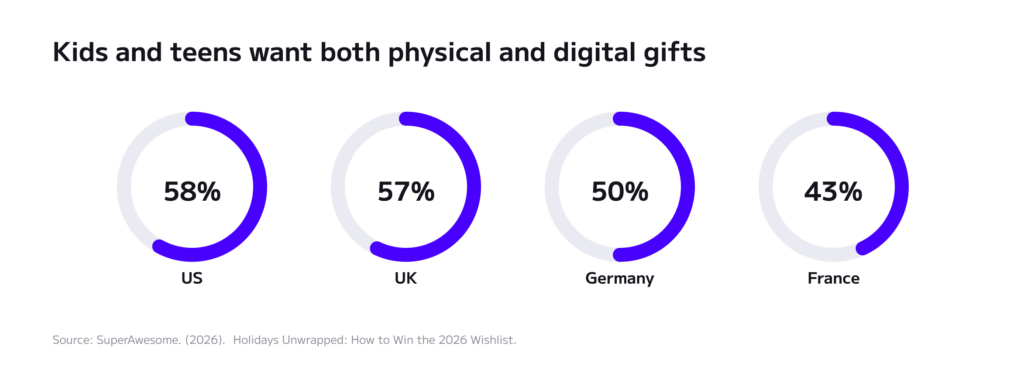
Gaming sits at the center of this hybrid wishlist. In the US, it’s named the universal holiday wish, with young people requesting the full ecosystem, from games and consoles to in-game items and currency. Across France and Germany, wishlists also include consoles, titles, accessories, and digital currencies, alongside toys, technology, fashion, beauty, vouchers, and experiences.
For brands, the opportunity is to connect the physical and digital sides of gifting through products, rewards, and experiences that continue beyond the unwrapping moment. Gift cards, digital codes, personalized bundles, and flexible “pick your own” mechanics can also make choice part of the gift itself.

Winning the 2026 Wishlist Starts Now
The path to holiday purchase begins with young audiences. Parents want to get the gift right, but kids and teens often provide the specific direction they need. Brands that build recognition early, make their products easy to ask for by name, establish social proof, and create flexible physical and digital gifting experiences will be best positioned to make the 2026 wishlist.
Want to Dive Deeper?
Download SuperAwesome’s full ‘Holidays Unwrapped 2026’ report and unpack the insights shaping kid and teen shopping behavior across the US, UK, Germany, and France:
🇺🇸 US Report | 🇬🇧 UK Report | 🇩🇪 Germany Report | 🇫🇷 France Report