
Over the past week, I’ve found myself thinking a lot about how quickly things can change in our industry. If you’ve been online at all, you’ve probably seen the headlines. News around Taylor Frankie Paul – one of the most recognizable faces tied to “MomTok” – has been everywhere, and it’s even been linked to broader conversations about TV programming and canceling this season of ABC’s The Bachelorette.
I’m not here to give my personal opinion on the situation. But I will say this: moments like this are a very real reminder of how important it is to truly understand the talent we choose to work with.
Because in today’s world, creators aren’t just creators. They’re public figures, role models, and in many cases, the face of major brand partnerships – especially when those audiences include kids, tweens, and teens.
And that’s where this gets serious.
Why This Hits Close to Home for SuperAwesome
At SuperAwesome, we work with families. We work with moms. We work with young audiences. And we work with brands who want to show up in those spaces responsibly and safely.
So when something like this happens in the creator ecosystem, it’s not just “industry news.” It directly reinforces why we approach creator vetting the way we do.
Because safety, trust, and appropriateness aren’t optional in youth marketing – they’re everything.
The Shift We’ve Been Seeing
Over the past year, I’ve noticed a big change in how our clients review talent.
We’ll send over curated creator lists, and almost immediately, those names are being plugged into tools like ChatGPT or Gemini. Within seconds, every article, every Reddit thread, every snark page is surfaced.
And honestly? It can be scary out there.
Because here’s the reality: almost every influencer has something written about them online.
Not all of it is true. Not all of it is fair. But AI doesn’t always know the difference.
Where We Come In
This is exactly where SuperAwesome plays a critical role. We don’t just gather information, we interpret it.
We look at everything: headlines, Reddit threads, snark pages, social commentary. But more importantly, we validate what’s actually accurate. We build real relationships with our creators and have direct conversations with them about what’s being said online.
We look at it through two lenses:
- AI for discovery and scale
- Humans for context, judgment, and truth
Because context is everything.
The SuperAwesome Star System
Last year, we formalized this into the SuperAwesome Star System, which we now use for every recommendation.
Every creator we suggest is vetted by our in-house legal and compliance team. We evaluate across four key areas:
- Reputation: What’s being said, and what’s actually substantiated?
- Content: Is it appropriate for the intended audience?
- Authenticity: Does this creator show up in a genuine, trustworthy way?
- Quality: Is their content consistently strong?
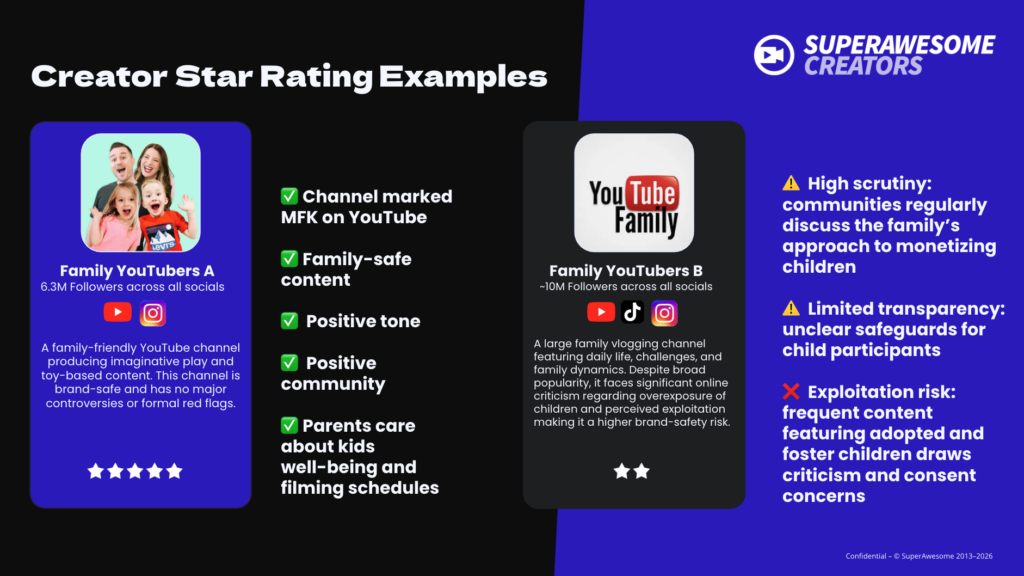
Each category is scored from one to five, resulting in an overall star rating.
Sophie Hughes, SuperAwesome’s Legal Counsel for Creators Business, explains our role as going “beyond mitigating risk. It’s about protecting the integrity of the recommendations you rely on. That’s why the SuperAwesome Star System looks far beyond follower counts. We assess public records and content history to build a complete picture. A five-star rating reflects a rigorous review, confirming a creator is not only talented, but also a safe and ethical choice for our audience.”
A five-star creator is what you’d expect: exemplary across the board, aligned with brand values, and free from past or current controversies.
But we always like to clarify this – because it’s important:
Five-star doesn’t mean “the only option.”
Let’s Talk About Nuance
The internet is not black and white. And neither are creators.
There are incredibly talented people out there who may have Reddit threads about them, or have been the subject of online criticism – or even bullying – that isn’t fully accurate.
We take all of that into account.
So when we bring a three- or four-star creator to a client, it’s not a red flag; it’s context.
It means: this creator may have some online conversation around them, but here’s what’s true, here’s what’s not, and here’s why they could still be a great fit depending on your brand, your audience, and your risk tolerance.
Some brands want ultra-safe. Others are more open to nuance. Our job is to guide both.
It Doesn’t Stop at Vetting
Something I’m especially proud of is that our work doesn’t end once a creator is selected.
Our legal and compliance team reviews everything – content, concepts, scripts, executions – before anything goes live.
Because when you’re speaking to the next generation, there is no room for shortcuts.
The Bottom Line
At SuperAwesome, we’ve built our approach to be human-first, supported by AI – not replaced by it.
Because when brands show up in youth spaces, they don’t just need reach.
They need responsibility.
They need context.
And most importantly, Going back to the news around Taylor Frankie Paul – I won’t say what Star Rating she’d get from our legal team, but you can guess 😉
Reputation is not static. It evolves in real time. And without a strong, human-led vetting process, it’s very easy for brands to either overreact or, worse, overlook something important.
If there’s one thing I hope more people take away from moments like this, it’s that creator vetting isn’t just a step in the process.
It is the process.
they need trust.
And trust starts with who you choose to work with.