

When I tell marketers that teens are driving youth culture, they usually push back. For years, marketers have worked on the assumption that influence travels downwards.
Kids look up to teens. Teens look up to young adults. So, if you want to reach a 15-year-old, you show them an aspirational 21-year-old.
Simple.
Except our latest research, Culture Makers: How Teens Define Fandoms, Trends & Spends, suggests that youth culture does not work like that anymore. Teens are not waiting for young adults to tell them what is cool. They are discovering, interpreting, and spreading culture themselves, and young adults know it.
Brands need to reshape how they think about youth audiences: teens are now a distinct cultural force, not just the younger end of the 13-24 demographic.
We Need to Reframe What Aspiration Is for Youth Marketing
The old model tells us that teens aspire upward, but the individuals supposedly setting the standard are looking in the opposite direction. The behavioral data showed us across multiple ways that teens are leading Youth Culture, from search to viewing, Young Adults are looking to teens, from working out what the latest Gen A slang is to reveling in content that is teen coded.
The individuals’ accompanying survey responses help explain the why: 76% of young adults say they often or sometimes watch content that feels as though it was made for a younger audience, while only 3% say they never do. The reasons range from humor and comfort to nostalgia or simply genuinely enjoying the content, reflecting how younger years can hold a particular appeal when adulthood feels increasingly daunting.

Which means teen culture’s influence extends well beyond teen audiences.
So, What Makes Teens So Culturally Influential?
They occupy a unique position. They are still experimenting with who they are, what they like, and where they belong. At the same time, they have enough independence and social visibility to turn those experiments into signals to others. What they watch, wear, quote, play, share, and recommend becomes part of how they construct and communicate identity.
Children can look to teens as the next attainable version of growing up. Young adults can look back on teen culture for novelty, entertainment, and a sense of what is current and what was emotionally comfortable. Teens sit right in the middle.
This is also why grouping everyone aged 13 to 24 into one convenient youth audience can be problematic. While teens are still forming their identities, exploring who they are and seeking belonging and peer validation, young adults are expressing more established identities, with a greater focus on personal preferences and practical usefulness.
They may be using the same platforms, but they are not using them with the same mindset. A single campaign cannot always bridge that difference.
The Feed Is Only the Starting Point
Spotting something in a feed is not the same as turning it into culture. The algorithm might introduce a new idea, creator, product, or joke. What happens next is where teen influence becomes really powerful.
One teenage participant told us:
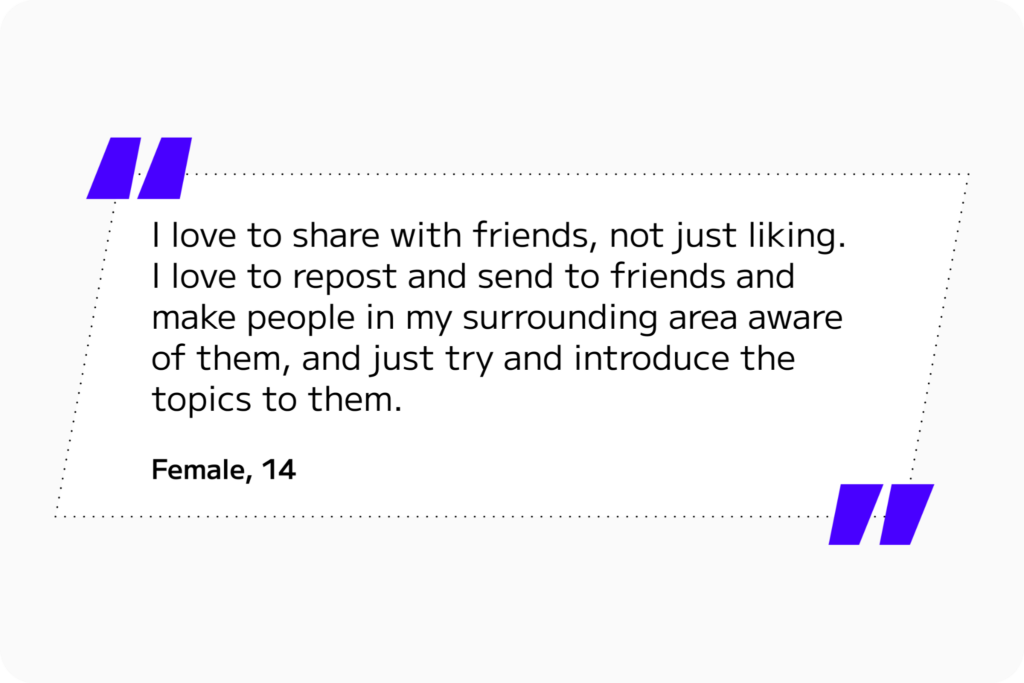
Content moves beyond consumption into active sharing and circulation.
Teen influence works like a relay, as they encounter something, work out what it means to them, and pass it on to the right people, bringing it into everyday life through conversations at school, creating their own versions, joining fandoms, wearing or playing it, and creating UGC around it.
The interesting part is that much of this cultural activity happens somewhere brands cannot easily see it, in the group chat.
The Hidden Power of Private Sharing
In our study, 1/5 of teens had privately circulated a recent discovery among people they knew. But it is not simply the volume of sharing that matters. It is the role that sharing plays in teen relationships. Two-thirds of teens described private sharing as community-forming, compared with 46% of young adults.
As another teen explained:
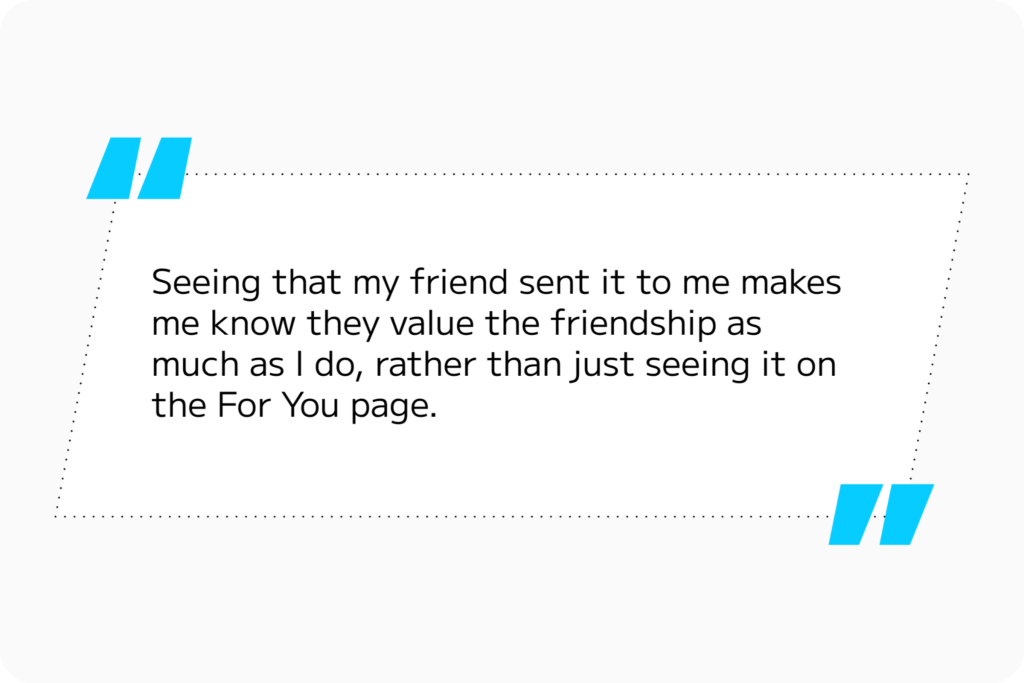
The exact same piece of content can mean something completely different when it comes from a friend. A private send might mean this is so you, we need to try this, look at this proof, or can we get this? It might make an idea feel funnier, safer, or more relevant. It might give someone permission to join in. It can turn an algorithmic discovery into a shared reference point.
The feed creates visibility. Friends create meaning.
When was the last time you saw a teen excitedly share a piece of brand content that gave them nothing to say, add, or do? Simply being seen is not enough. Brands need to be sendable.
Teens Choose, Even When Adults Pay
This influence also extends into purchasing, although traditional attribution does not always capture it. Some 77% of teens told us that they had asked a parent or someone else to order something they had seen or researched during the previous three months.
A teen might discover the product, research it, select the exact version, and persuade someone that it is worth buying. A parent then approves the purchase, provides an account, or completes the transaction. The adult owns the transaction, but it’s the teen who owns the demand.

If we only look at the final click, the payment card, or the name on the account, we risk missing the person who created the want in the first place.
This is particularly important because teen purchase journeys are often relatively short. Creators, friends, and cultural relevance act as shortcuts. They help teens decide what deserves attention and what feels safe or worthwhile to choose. By the time a parent becomes involved, the teen may already have made up their mind.
What This Means for Your Strategy
If teens are driving culture, brands need to stop treating them as slightly younger young adults. Here are four things I think marketers should build into their strategy:
1. Treat Teens as a Distinct Audience
A campaign designed around the independence, routines, and priorities of an 18 to 24-year-old will not necessarily connect with someone who is still forming their identity. Teen strategy needs to start with the teen life stage, not with a younger version of an adult campaign.
2. Use Teen Behavior as an Early Signal
If an idea, creator, or piece of content is gaining traction among teens, it may tell you where wider youth culture is heading. Do not wait until a trend reaches young adults before deciding it matters.
3. Design for Sharing and Participation
Ask whether the content gives teens something to pass on. Is it funny enough to send to a friend? Does it express a feeling or point of view? Can it be remixed, referenced, or turned into an in-joke? The best teen content turns a view into a conversation.

4. Build for the Real Purchase Journey
Teen demand may move from a social feed to a group chat, then to a search, a retailer, and finally a parent-assisted purchase. Make that journey easy by giving teens clear product information and something credible to show the person who may ultimately approve or pay for it.
Where We Go From Here
Teens are not standing on the sidelines, waiting to see what becomes popular.
They are scouting for new ideas, making sense of them, sharing them with friends, and turning them into conversations, identities, fandoms, and demand. For brands, that creates a big opportunity. Reach teens in the right way, and your impact may extend well beyond the teen audience.
But it requires a change in mindset. Stop asking how to make young-adult culture appealing to teens. Start asking how your brand can become a credible, useful, and shareable part of the culture teens are already creating.
If you are still waiting for culture to trickle down from young adults, you may already be late.
Want to Dive Deeper?
Download SuperAwesome’s full Culture Makers report to discover how teens really define fandoms, trends, and spend, and what it means for your brand.
Source: SuperAwesome Culture Makers Study, H2 2026. Consented behavioral data, quantitative research amongst 1,909 people aged 13 to 24 in the USA, supported by 100 qualitative interviews.
