

To celebrate Safer Internet Day 2026, members of the SuperAwesome team have curated a series of blogs featuring expert insights on youth privacy and safety, with perspectives from our legal, product, and insights teams. In this blog, our Global Head of Youth Trends and Insight, Sam Clough, examines parent and youth perspectives on social media bans for under-16s, and how we can move toward a truly safer internet.
For Safer Internet Day 2026, we polled 400 parents of under-18s across the USA, UK, France, and Germany, and also spoke to kids & teens aged 7 – 18 from the UK and USA. We wanted to understand how they think the internet could be made safer for this generation and for those to come, and we also delved into the hot topic of the moment: whether under-16s should be able to access social media.
What came through very clearly is that while many parents do support a total ban on social media for all under 16s, a large proportion of parentsdon’t.But there is widespread support for some sort of restriction and, most importantly, accountability to create a safer internet for kids and teens.
These responses centre on bans for younger children (under 13s), graduated access for older teens, and stronger age enforcement. While kids and teens will always find workarounds, a total ban could backfire, driving the appeal of these ringfenced spaces. So you could say that parents and young people are open to social media at the right time, but when it is supervised and/or safe.
The reality, though, is that a social media ban will address only a small part of children’s digital experience, while kids, teens, and parents alike want a better internet as a whole.
So, what do parents and children think is a safe internet, and how do parents help their children stay safe on the internet at the moment?
1. Protection from Strangers & Harmful Contact (Parents and Kids/Teens)
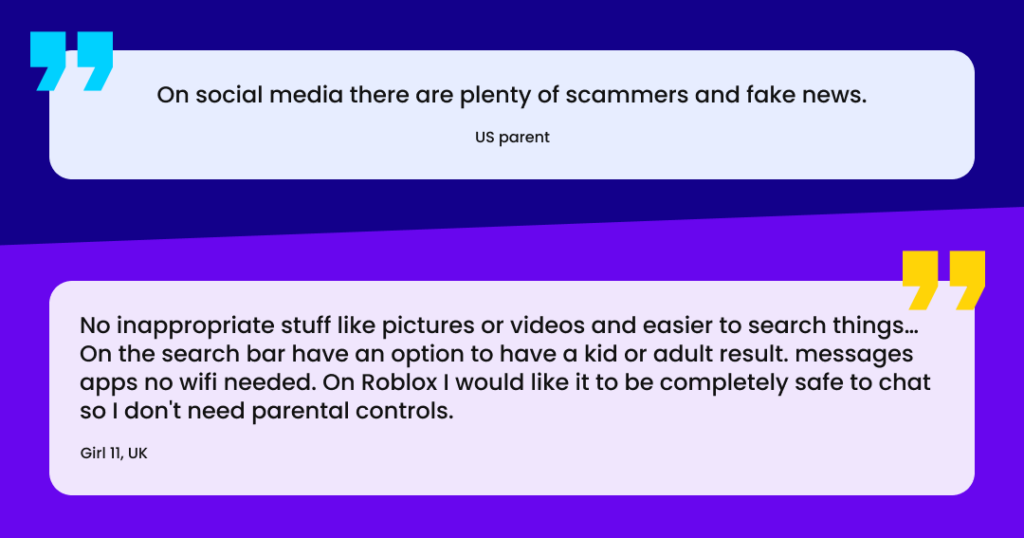
Protection is, by far, the most common theme from parents, kids, and teens, covering grooming, random (adult) contact, as well as scams and manipulation. These core fears are present everywhere and at all ages. The clarion call is to help ensure that all digital spaces, not just social media, are places where you can trust that your child won’t be affected or targeted by those with nefarious intentions.
2. Age-Appropriate Content (Parents and Kids/Teens)
Parents, kids, and teens agreed that they look for ways to ensure what they are engaging with is right for them. This is about understanding who the content is for and what a platform stands for, and ensuring they don’t encounter material they shouldn’t in spaces that claim to be appropriate. There is a clear desire for platforms to take accountability here too, with better signposting and better enforcement of existing rules.
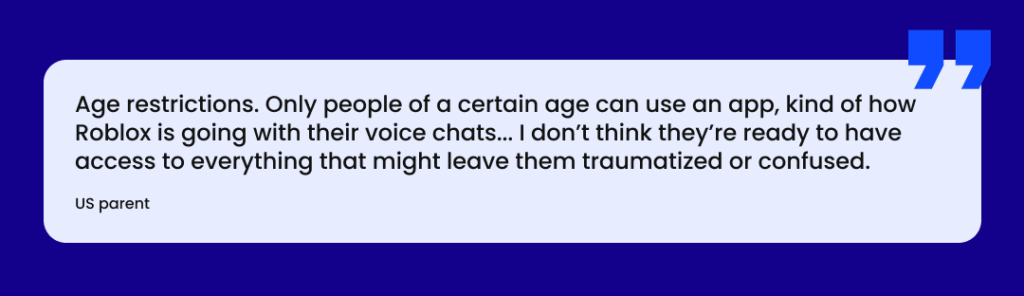
Young people, though, also want clarity and predictability, especially in spaces that are ‘for them’.
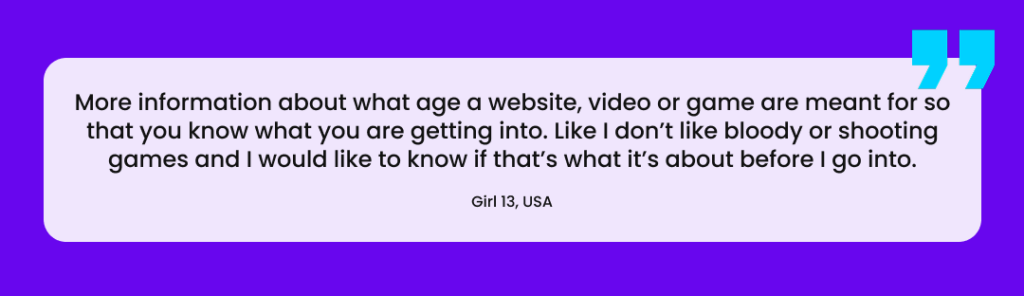
Across countries and ages, parents, kids, and teens aren’t asking for perfection; they’re asking for honesty, clarity, and enforcement, so that spaces designed for young people truly feel safe.
3. Platform Accountability (Parents)
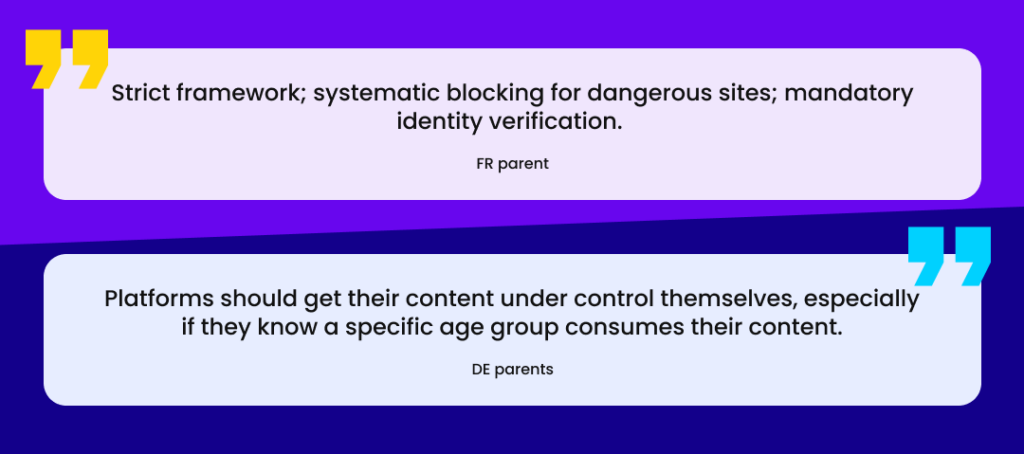
While acknowledging their own role in ensuring kids and teens are safe online, parents also demanded greater accountability from platforms, especially in France and Germany.
Parents can feel alone in trying to manage their kids and teens’ online safety, and don’t believe that they should be the only line of defence in combating the risks of letting their children go online.
Keeping young people safe online is a herculean task, with constant change and the fragmentation of media making it feel like an ever-changing quicksand. Parents’ calls for help need to be acknowledged and acted upon. Ensuring spaces are designed with kids and teens in mind as a default, while providing parents with the information and tools they need, will go a long way to creating a better internet for young people.
4. Reduced Addictive Design (Parents and Teens)
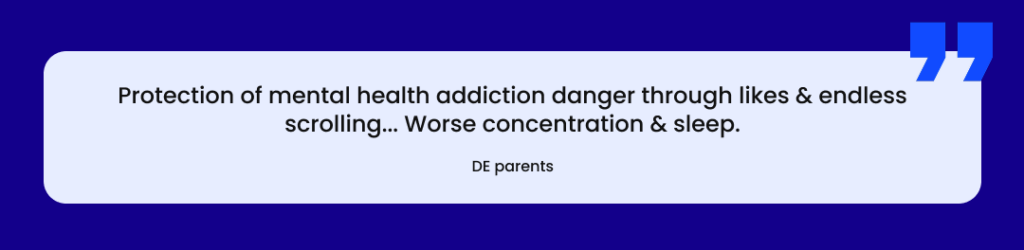
Finally, parents (and older teens) are concerned about the dangers posed by algorithms. This isn’t just about screen time (though it plays a part in the perceived negative effects); it’s about the content young people see and the echo chambers they can fall into.
Endless scrolling and its effects on attention, sleep, and the risk of exposure to inappropriate content are key issues parents want addressed. Parents worry about the effect on kids’ and teens’ mental health. And while they can, and do, create family rules to help guide behaviour, parents and children alike are looking for more responsible algorithms to keep them safe online.
Parents Don’t Want to Spy; They Want Better Tools, and Talking Definitely Beats Blocking
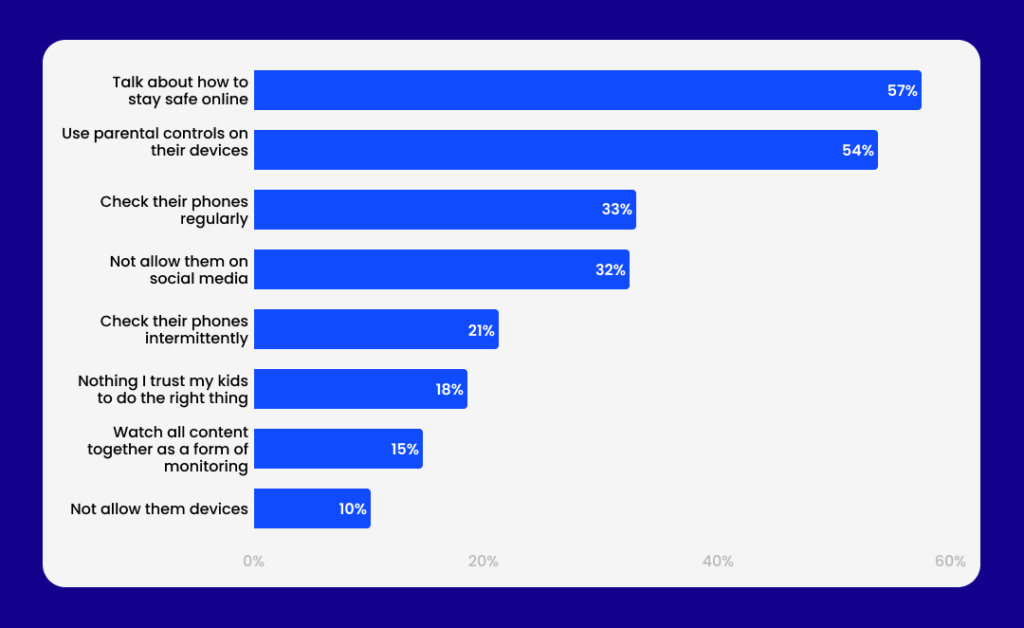
What came through clearly from our research was that open conversation is at the heart of keeping kids and teens safe. Nearly 60% of parents acknowledge that talking to their children is at the heart of their safety strategy. But this is closely followed by judicious use of parental controls, especially for younger children.
Interestingly, this varies widely by country, with the UK and Germany leading the charge on conversation. Prohibition of social media features for a third of parents (mostly of younger children), while phone checking and co-consumption of media, especially in Germany, are also key tools in their toolbox.
Overall, kids and teens align with their parents’ views, meaning family conversations are critical for equipping them with the tools to keep themselves safe online. That said, they also think parents should use the tools available to them as an additional layer, especially for under-13s. And the younger they are, the more oversight they want from their parents. Which figures – kids and teens know that it’s their parents’ job to help keep them safe, in both the real and the digital world. Parental oversight is not intrusive; it helps them confidently navigate the internet and contributes to a safer experience.
Key Safety Strategies for Parents:
1. Talking is at the heart of parents’ strategy; it’s an ongoing conversation that builds trust and equips young people with the ability to judge for themselves, giving them the tools they need to keep themselves safe now and in the future. Parents across all markets view media and digital literacy as a key life skill.
2. Supervision and control, similar to talking, most parents don’t sit back and let their children get on with it; they are monitoring devices and content, and co-viewing / gaming to understand what is being consumed. In fact, this is a useful part of the conversation.
3. Parental controls are a useful part of their arsenal, but they can’t do everything, which parents acknowledge
So, Is Banning Social Media the Answer?
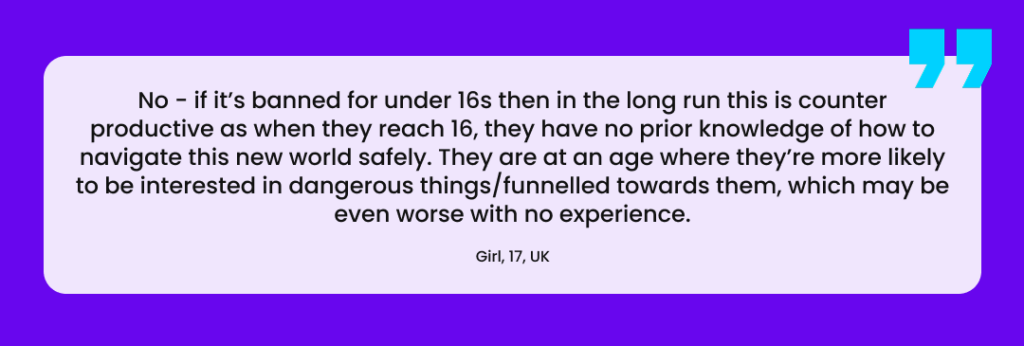
According to our findings, probably not. The situation is more nuanced than a straightforward ban, and it seems unlikely that a total social media ban for 13 – 16 year olds would make all of the spaces young people spend time online safe.
What is clear, though, is that parents, kids, and teens expect tech companies to do more to keep children safe online, with clear call-outs to minimise harm, increase regulation, and create better age verification, especially when it comes to addictive loops and adult content.
There is a parent-and-child consensus that there should be some form of social media restriction (at either 13 in the US/UK or 16 in France and Germany), but that this should allow teens to ‘learn with guidance’ while keeping those too young to manage risks safe.
Parents in the UK and US frame keeping safe around education, responsibility, and supervision, while those in France and Germany are more likely to emphasise regulation, platform responsibility, and enforcement.
Across all four countries, parents and children agree that the internet should not be a free-for-all for kids and teens: safety, age-appropriateness, and adult support matter more than total bans. A safer internet is one where young people can explore without being exposed to people, content, or pressures they’re not ready for, and where parents aren’t left to manage those risks alone.
A Green Cross Code for the Internet
For me, personally, I think it’s about guiding our children to safety. I would call for a ‘green cross code’ for the internet. Learning how to navigate social media and other digital platforms is a life skill that should be transferable. When we teach our children to cross the road, it’s progressive. We start by holding their hands, taking them to the zebra crossing, and gradually, reluctantly, letting go so they can walk beside us before allowing them to walk on their own. We don’t tell them to cross a busy highway without teaching them how to cross safely on their own. So my request is that platforms put the infrastructure in place and work with experts to help develop that code, so that parents and children alike can have a safer, better digital experience.
At SuperAwesome, we’re dedicated to powering a better internet for the next generation. We help brands reach young audiences safely and responsibly, with guaranteed compliance and a deep understanding of local regulations and cultural nuances.
Through our in-house legal teams and local experts, we proactively uphold rigorous standards to safeguard both brands and the audiences they connect with at every step. We believe creating a safer digital world is a shared responsibility, which is why we’re committed to continuing these conversations openly – with parents and non-parents alike – as we work together to shape a better internet for kids and teens.